On Institution Building
Redefining advanced business education for the betterment of society
August 2025
Back to School
Business school was never on my mind. For the longest time, I have yearned to pursue a PhD in public policy or economics, but about three years ago, I steered my life in a different direction and I currently reside in a remote part of Maharashtra at one of India’s youngest yet most promising private business schools. I say “promising” not only due to the substantial amounts of capital, resources, and network at the school’s disposal, but also because of the school’s determined leadership that comprises world-class academics and industrialists all aiming to revolutionise business education in India.
I have been at the school for over a year now and as someone who is experiencing this first-hand, I have made several observations around how institution building requires careful attention to five key pillars: Admissions, Academics, Research, Labour Market Relationships, and Faculty. In this newsletter, I aim to share my thesis on what is needed to take a business school from 0-1 in a hyper-competitive world.
Admissions
Admissions is arguably the most confusing part of any business school’s priorities. Which students are we targeting? Which students do we admit, and which do we keep out? How many students do we admit? All these questions and more make life hell for any school administrator because students are what bring life, culture, and significance to any educational institution. However, in the context of business schools, although the questions might be similar to other educational organisations, a fundamental premise must be established to distinguish it from the rest. My premise is this: The purpose of business education is to train and refine professional judgement, and not merely to impart theoretical knowledge.
At first glance, this thesis may seem obvious and practical, but putting this into practice has several first order consequences. Here’s one: business schools in India should break free from the mould of admitting droves of students with no work experience. The reasoning behind this is simple. First, consider the base purpose of any business school. Unlike undergraduate programs that aim to build foundational knowledge, business schools are designed to train and refine those that have already been exposed to the corporate and/or startup world. This is not simply an academic distinction; it fundamentally affects the quality and depth of learning that occurs in a classroom. Admittedly, when looking at the larger picture, one must consider the fact that this behaviour is unique to Indian business schools as this is rooted in a cultural aspect of “finishing off” one’s education before one “settles down” (i.e., get married and start a family).
However, the second order effect is the Experience Multiplier. When the classroom comprises a majority of students that come with work experience, discussions become richer, each case study more nuanced, and each project more grounded in reality. Moreover, the learning becomes less vertical (professor > student) and more horizontal (student <> student), creating a more dynamic educational environment. Regardless, this brings up an interesting discussion about fresh graduates in business schools.
While this cohort of students often brings excellent academic credentials and analytical minds to the table, their journey in a business school takes a different path from their experienced peers. Fresh graduates often excel at rapid learning and bring interesting perspectives to business problems, bereft of preconceived notions. Furthermore, their technological nativeness and adaptability are particularly valuable in discussions around digital transformation.
However, the question is not about capability, it is about optimisation. Just as Usain Bolt would not become a running coach without his years of experience, the full value of an advanced business education is best realised when it is built upon a foundation of practical experience. Hence, we see global business schools such as HBS, GSB, INSEAD, and even homegrown institutions like ISB prefer candidates with work experience not because fresh graduates lack potential, but because the business school curriculum is designed to build upon professional experience.
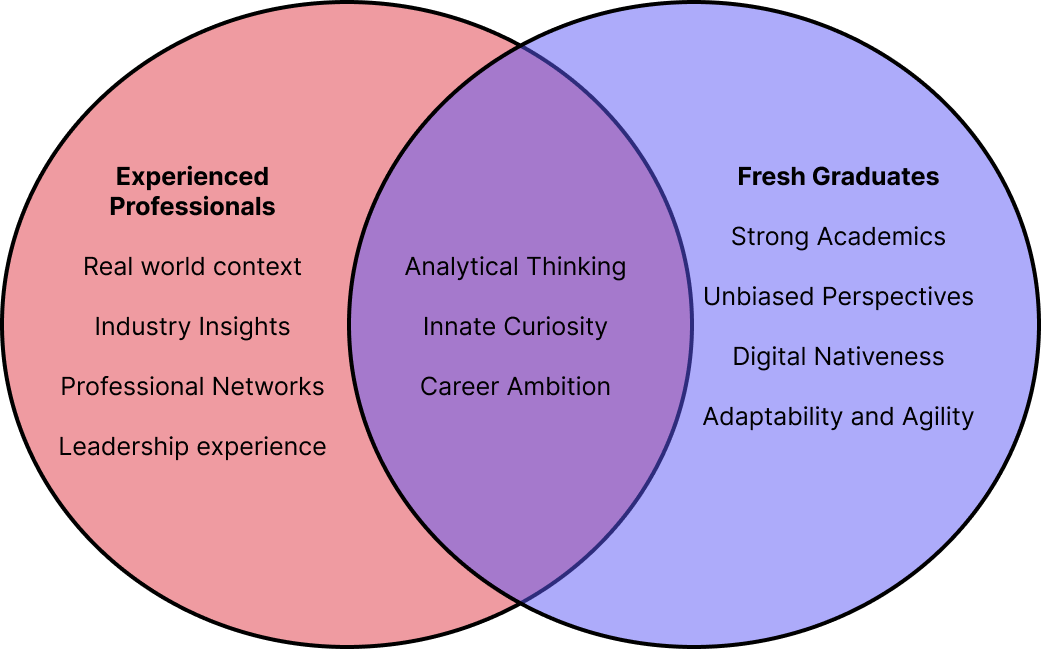
Therefore, this raises the question of what the ideal admissions strategy should look like. Here are some key elements:
Class Composition: The ideal batch size should range from 120 to 250 students. This range ensures intimate learning environments while maintaining just the right amount of diversity of thought and experience. Too large a batch risks diluting the learning process as the student to professor ratio skews poorly, and too small a batch limits the student <> student learning experience.
Work Experience: A minimum of two years of work experience should be a standard barrier in the admissions process. Exceptions should be made only for truly extraordinary candidates who display outstanding work ethic not only through academic accomplishments but through a genuine desire to learn from the world. The average work experience of the class should range between 3-5 years, allowing for a healthy mix between early-career professionals and more seasoned individuals.
Diversity Metrics: Beyond the usual sex ratio (M/F/O), the key focus must be on industry and academic diversity. India has a poor history of business school classes being filled primarily with those coming from a technological background (engineers) as they are primarily more adept at clearing competitive entrance exams due to their advanced quantitative aptitude. Therefore, any new business school should prioritise dividing their classes across disciplines — technology, manufacturing, consulting, entrepreneurship/family businesses, design, and the social sciences. This diversity is key in ensuring holistic peer learning and network building.
International Exposure: A crucial yet often overlooked factor is prioritising students who come with international exposure either through work experience or education. Thanks to their global outlook, such candidates bring substantially different and vibrant perspectives to a classroom, allowing some discussions to weave local contexts to global best practices.
The “ideal” student body I have outlined above isn’t just a theoretical musing — it fundamentally shapes the academic experience that follows both for professors and for students alike. The right mix of students creates what I call a compounding learning environment wherein classroom discussions are deeper, networking is more valuable, and the educational experience transcends beyond the textbook.
However, building the right class requires the school to also have offerings that attract the right candidates. In an Indian business school this hinges on two things — labour market outcomes and academics. Without the latter, the former becomes much harder to achieve, and so in the following section let’s explore how a nascent business school can craft a curriculum that not only meets the industry standard, but also is forward looking, in that it predicts future trends all while maintaining the rigour of a world-class institution.
Academics
Across disciplines, including management education, academic structures mimic what has worked in the past rather than what might work in the future. In India, business schools broadly fall under two categories:
Semester/Trimester System: Under this structure, students are expected to study multiple subjects, across different disciplines, simultaneously across 2-3 months. Each of these sections of 2-3 months make up a semester or term, and an academic year ideally consists of three terms, hence the moniker “trimester”. Within each term students are consistently assessed through group projects, closed/open book examinations, and individual assignments that test based on the curriculum taught in class.
Block System: A relatively newer academic pedagogy that has gained traction in some private universities, this system looks at a complete academic unit as a “block” comprising 2-4 weeks. In those few weeks, students are expected to finish an entire module or “subject” that would typically be taught across the semester. This includes projects, assignments, and examinations related to the course material. As such, material is typically condensed to adapt to the limited time.
However, both the semester and block system have their shortcomings. Under the semester system, students could face intense cognitive overload due to multiple subjects, assessment challenges due to clustered projects and tests, and the Waterfall Effect as learning prerequisites might not be too clear, early misunderstandings can cascade quickly thereby hindering the understanding of advanced topics, and knowledge gaps are realised only during pre-exam prep.
Under the block system, subject matter is difficult to condense, and in the off-chance that the curriculum is not appropriately adapted to the timeline, a learn and dump syndrome kicks in where students gain knowledge for a short period of time to pass assessments, and do not realistically build any cumulative knowledge. Practically, students might find it hard to recover between blocks, and any absences within the block might lead to critical learning loss. Finally, aside from the students, faculty might find it difficult to deliver vast amounts of content quickly and provide detailed feedback to students on their graded assessments.
Since clearly both systems have shortcomings, let us try and come up with an alternative. Here is the Blended Applied Learning Track (BALT) that combines the focus of the block system and the integration of the semester structure. In essence, this novel framework’s academic pedagogy focuses on three broad disciplines — financial knowledge, understanding markets, and quantitative methods. Here’s how it would breakdown:
Foundation for Core Knowledge (8 weeks, June — July):
Financial Knowledge: Corporate Finance and Accounting (3-4 sessions/week)
Understanding Markets: Microeconomics (3-4 sessions/week)
Quantitative Methods: Business Statistics (3-4 sessions/week)
Practical Integration Block 1 (6 weeks, August — Mid-September):
Intersection between economics and finance
Live company financial analysis projects — become a master of Microsoft Excel, company research, and diagnosing organisations
Guest lectures/workshops on careers in banking, public markets, venture capital, private equity
Major Assessment 1: Prepare and present an industry analysis report similar to those done by equity research firms
Application Sprint (2 weeks, End September):
Sponsored business problem challenge
Skills workshops (financial modelling, market research, data analysis)
Career building workshops
Practical Integration Block 2 (6 weeks, October — Mid-November):
Advanced Corporate Finance
Fundamentals of Marketing
Business Statistics 2 — using data to drive firm-level financial and marketing decisions
Application Sprint (2 weeks, End November):
Immersive industry experience based on electives
Advanced tools — Python for Finance, Advanced Microsoft Excel, Database Research, SPSS/STATA, Tableau
Industry networking opportunities
Inter-collegiate business case competitions
Practical Integration Block 3 (6 weeks, December — Mid-January):
Financial Markets
Marketing Strategy
Mathematics for Management: Operations
Application Sprint (2 weeks, End January) (one of any):
Startup immersion — meeting and working with startup founders on small-mid sized business problems
Technology workshops — theoretical and practical applications of bleeding-edge technology that drives global transformation
Leadership seminars — interacting with innovators and managers operating at the frontier of technological and organisational development
Practical Integration Block 4 (8 weeks, February — March):
Investment Analysis
Corporate Strategy
Business Analytics (Capstone Project)
Year two of this program is expected to be similarly structured with the subjects switching out for Business Operations, People Management, and Public Policy — subjects that are possibly less quantitatively challenging, but nonetheless an integral part of any advanced business education curriculum. Naturally, as the theoretical structure of the year changes, so will the practical side of things i.e. the startup problems that students will be expected to solve plus the workshops and seminars they will be expected to complete.
Finally, starting with the second year’s application sprint that begins during the end of November, students will be assisted in finding themselves jobs that suit the career they are looking to build. In this effort, the school itself will have to converge across multiple other functions (more on this in subsequent sections), however, from both a theoretical and practical standpoint, students will be more than ready to be grade A professionals regardless of their background prior to the business program.
This hybrid academic system is meant to create a well-rounded curriculum that challenges students to build the hands of a practitioner and the mind of an academic. The advantages of this, and the goodwill it generates for stakeholders across the educational ecosystem, are thus multi-fold —
Students: For students, the BALT gives any learner the opportunity to build upon their foundational and advanced theoretical knowledge through industry exposure via workshops, startup immersion programs, and leadership seminars. This creates a well of knowledge within each student which when applied within organisations, can unlock outstanding value across different business functions. The program is designed in such a way that regardless of the size of the organisation, complexity of the business problem, and the student’s background, any learner will be more than equipped to create a lasting difference.
Faculty: For faculty, the BALT forces any teaching member to keep current with their respective industry and pushes them outside of the cookie cutter academic model that many faculty bodies have been accused of. Furthermore, the industrial component of the BALT allows faculty members to build strong relationships between the university and real life practitioners.
Recruiters: For recruiters, students who come from BALT schools become easier to hire, train, and onboard since they come with the rigour that a BALT school demands both from an academic and practical standpoint. Given that BALT-exposed students will have already gained hands-on problem solving skills across three application sprints of 15 weeks total (including a summer internship between years 1 and 2), they are perfectly primed to take on cross-functional, high-impact, demanding jobs regardless of their prior professional experience. Academically, BALT students are either on-par or beyond top-tier MBA students as the curriculum structure is designed to cover all fundamental business subjects theoretically and requires students to marry their learnings to real industry outcomes during their application sprints and internships.
Research
For any academic institution, research is the lifeblood that fuels its reputation and relevance. Regardless of whether PhD scholars are being trained at the institution, it is vital that faculty members engage in high quality research that reflects their thinking and ability to evolve as economies, industries, and technology changes. This mindset towards research is all the more pivotal for a nascent school that is building a brand. Rigorous research cuts through the noise and provides a strong signal to recruiters, academics, and education professionals about the quality of the business school and the training that students under its tutelage receive.
It is also vital that research culture be rooted in quality over quantity, focusing on impact and visibility and not just about producing papers but shaping thought leadership and contributing meaningfully to both academia and industry. As such, publish-or-perish models that are so prevalent should be dismissed and collaboration over competition must be encouraged even within the faculty body.
There are several key pillars that a new business school should focus on when establishing a robust research ecosystem:
Faculty <> Industry: For some fields, research can afford to live either partially or wholly inside an ivory tower. In this regard, management research is unique — it is near impossible for academics to disseminate relevant research without rooting their work in real-world business problems, which can only happen when industry collaborations are formed (something the BALT excels at, as mentioned before). This enmeshing of industry and academia ensures that research is both intellectually rigorous and practically relevant alongside being immediately applicable. An example of this could be faculty members collaborating with companies on case studies that explore current market realities, or work with government bodies on policy research that is relevant to the Indian business landscape.
Interdisciplinary: Management research has the capability to encapsulate several different fields of work into one. The most impactful research is that which is applicable across a variety of different disciplines. For example, during my time at the LSE, I worked on research problems in the management space through the lens of choice architecture, judgement, and decision making, thus merging behavioural economics with classical management problems. This form of research fosters innovative thinking and leads to sharper insights that single discipline research might miss.
Quality > Quantity: Throughout the life of the university, research culture must focus on producing high-quality, impactful publications in reputable national and international journals. However, this is easier said than done. In order for faculty members to build a body of work during their tenure at the university, key resources such as research grants, access to high-quality, accurate data, and dedicated time for scholarly work is of absolute necessity. Naturally, chasing a high number of publication numbers in lesser known/impactful journals will dilute the school’s signal of rigour, excellence, and quality.
Research Centers and Initiatives: As time passes, the university will start to gain faculty members that have deep expertise in certain fields or sub-fields of management research. For example, at the Indian Institute of Management, there are specialised centres for Capital Markets, Management Communication, Corporate Governance and others. These centres attract significant research funding and foster collaboration between researchers across different disciplines. Centres can also function as knowledge hubs, hosting seminars, workshops, and conferences, and enhance the school’s research profile.
Dissemination of Research: For research to truly make an impact, it must be made visible to a variety of scholars, schools, and other key stakeholders in academia and industry. Thus it falls upon the school to actively promote its research through various channels including websites, social media pages, and encouraging faculty to present their work at conferences. Research should also inform the development of every school’s curriculum by making sure that students are exposed to the latest in the fields they are studying and the industries they are keen to work in.
By focusing on these elements, a business school that is growing from 0-1 can build a solid bedrock of research output that not only showcases academic rigour to those external to the school, but also compounds the learning outcomes of students. The second order effect of cultivating a strong research culture and building an industry focused curriculum is a heightened interest in hiring from marquee firms. However, every business school has a standalone function dedicated to handling this aspect and as such, labour market relationships are vital to closing the loop on a business school’s investment in its students.
Labour Market Relationships
One of the primary reasons that students join graduate business programs globally is to enhance their career prospects through the student and faculty network they are exposed to, the academic knowledge they pick up, and the hiring drives they participate in. As such, for any business school, forging robust labour market relationships is paramount.
In India, the “placement cell” model is often more reactive and focuses primarily on job matching towards the end of an academic program. However, any new business school worth its salt must think forward and cultivate deep and lasting relationships with multiple stakeholders in the labour market. Here’s how:
Strategic Industry Partnerships: Outside of annual recruitment drives, a business school should aim to build partnerships with leading companies, startups, and even the public sector. Several ways in which these partnerships can manifest are:
Curriculum Co-Creation: Industry experts should be deeply involved in designing and updating curriculum modules ensuring that the curriculum remains relevant to current and future industry trends.
Guest Lecturers and Adjunct Faculty: Inviting senior professionals to deliver specialised lectures and even teach full courses helps bring in invaluable practical perspectives alongside a theoretical foundation.
Live Projects and Internships: The BALT system with its integrated application sprints is perfectly suited to facilitate a high volume of live industry projects and structured internships, thus allowing students to tackle real-world business problems and gain hands on experience throughout their program.
Mentorship Programs: Establishing formal mentorship programs where students are paired with industry veterans would help bring personalised guidance and networking opportunities.
Targeted Outreach + Brand Building: Every new school must actively showcase its unique value proposition to potential employers. This involves first, highlighting its unique pedagogy by emphasising the distinct advantages of the educational structure. In the case of the BALT system, it would be pivotal to talk about how graduates (regardless of their prior work experience and educational background) are both theoretically sound and as well as practically adept and business ready. Second, organising industry showcases, hackathons, and business case competitions where students can present their solutions to real problems, and demonstrate their skills to recruiters. Third, as the alumni base grows, actively engaging them as brand ambassadors and connectors within their respective industries boosts word of mouth marketing and helps foster powerful labour market relationships.
Market Intelligence and Feedback Loops: Remaining agile and responsive is critical when working with a dynamic labour market and as such gathering constant intelligence is crucial. This can be done through:
Regular Employer Surveys: Conducting periodic surveys and focus group discussions with recruiters to understand their hiring needs, skill gaps, and feedback on student performance.
Tracking Industry Trends: Dedicating special resources to monitor emerging industries, technological advancements, and shifts in job roles. This should directly feedback into curriculum adjustments, and faculty development.
Career Development Workshops: Offering constant career development support, including resume building, interview preparation, and negotiation skills that are tailored to specific demands of target industries.
Ultimately, the success of any business school within the labour market is rooted in the commitment it has towards producing graduates that are not just competent to do the job provided to them but to go above and beyond and be truly exceptional in all that they do. Proactively building strong, collaborative relationships with employers, the school can make sure that its students are sought after, thus creating virtuous cycles of talent development and impact in the industry.
Faculty
At the heart of any educational institution is the faculty body. A nascent business school’s faculty aren’t just teachers and professors responsible for imparting knowledge to students, but are flag-bearers of the school’s brand and reputation. They are the drivers of research and the mentors who shape students’ lives. Therefore, attracting and retaining world-class faculty should be a top priority. Any advanced graduate school should look beyond the traditional metrics that are taken into consideration when building the faculty body. The ideal mix should include a blend of distinguished academics and seasoned industrial practitioners, thus requiring a multifaceted approach to hiring, development, and retention.
Revolutionising business education can be visualised to be similar to Sisyphus and his boulder. Any new business school requires a faculty body that is willing to push that boulder through their deep theoretical knowledge combined with their practical, real-world experience. Here is how such a faculty body can take shape:
Academics <> Practitioners: The ideal faculty group as mentioned earlier should be a blend of two distinct yet complementary groups — one group contains research-oriented academics that have achieved their PhDs from top (ideally global) institutions that can build the research culture of the school from scratch and contribute to genuine thought leadership. The second are professors of practice that are industry veterans that bring decades of valuable experience to complement classroom theory with hands-on knowledge. Naturally, this hybrid model ensures that students are provided with a holistic form of learning where foundational theory and current industry practices are both picked up.
Hiring for Impact: Hiring policies must prioritise those individuals that not only have a strong research background but also those that have deep industry connections and are capable of bringing real life case studies and problems into the classroom. Within the hiring process, the number of publications must not be the only criteria that distinguishes a good hire from a poor one. The hiring process should also factor in a candidate’s ability to communicate complex ideas to diverse audiences, their passion for mentorship, and their leadership capabilities in the context of institution building.
Continuous Development: Since management research and business as we know it consistently evolves, a faculty body must also evolve with it. The school should invest heavily in constant faculty development, encouraging professors to attend industry conferences, take on consulting projects, and stay on the cutting edge of their fields.
Faculty Members as Institution Builders: Finally, in a new institution, faculty must be empowered to be more than just instructors to students. It is vital that all faculty members contribute to a school’s governance, help build industry relationships, and even participate in the admissions process. Giving faculty members this sense of ownership and involvement creates a motivated and committed faculty body that all work towards a shared vision of institutional excellence.
By creating a faculty body that is both thought leaders and hands on experts, a new school can ensure that its academic base is not just theoretically advanced but also relevant, dynamic, and transformative for students.
Pushing Things Forward
After a year of being at my MBA program, it’s become more and more clear to me that building a world-class business school from the ground up is a Herculean task that requires deliberate, thoughtful, and interconnected creation. This process requires a revolutionary mindset which is ready to challenge the current establishment and reimagine entire systems to achieve new excellence. Naturally, this success is not found in a smooth, single, strategy, but in an alignment across five pillars that work across different stakeholders within the management ecosystem and beyond.
These pillars are not independent, they are gears of a well-oiled machine where success in one, leads to success in another. The right students attract the right faculty, creating an academically rich environment, which in-turn encourages impactful research and graduates who are highly sought after in the labour market. At the helm of this machine lies the determined leadership that drives the entire system forward, ensuring that each function works in service of the whole.
Taking a business school from 0-1 is a long journey, filled with unique challenges, and this blueprint provides a small sense of guidance in this large tapestry of institution building. By focusing on these foundational principles, any new institution can lay the groundwork for a legacy that will redefine what business education means for a whole new generation of leaders across industries.