Valuing Early Stage AI Companies
Modelling out the next-gen venture opportunities of India
August 2025
Welcome back to Consortium.
One of the biggest struggles that venture capitalists have faced time and again is the practice of accurately valuing early-stage companies. The fundamental reason behind this is the complete lack of data that companies at this stage possess primarily because of how nascent they are — these companies are either entering a new market with a new product, or creating an entirely new industry on the back of revolutionary technology or a new business model. Thus, these businesses even at the earliest stages are prized assets in the venture market.
As the lack of data is more a feature than a flaw in early-stage companies, it falls upon the investor to look toward other forms of data that allow them to estimate what a new company is worth. In this edition of Consortium, I will attempt to value some of the exciting opportunities that I have found through my own reading and research1. I will follow a two part method — first, the venture capital method of valuing these businesses based on financial projections, investment values, and the P/E2 or revenue multiple, and second, a qualitative analysis using the 4M framework — Market, Management, Model, and Momentum.
Alongside “Whitespaces” that covers sector theses, this too will be another series of venture capital writing that is named — “Valuations”.
Happy reading!
Bhindi.io

Bhindi.io is an AI-native company that provides an agentic AI platform that is designed to transform natural language into actions across more than 100 platforms. Acting as a unified command centre for multiple interfaces, users can interact through one conversational terminal to automate their workflows — moving from more text based outcomes to intention driven automation. Some examples of how this technology is put to use —
Tracking CoinDCX portfolio changes, log your P&L and even receive Gmail notifications about crypto market shifts
Auto-review GitHub pull requests, use the Code Interpreter to comment on bugs and improvements
Trade stocks, check prices, and manage your portfolio through a chat interface
End-to-end outreach for influencer marketing — from finding creators to sending campaign emails all by using integrated Google Sheets and Gmail agents
The core idea behind this company is to solve the “AI fatigue” that people experience from switching between different AI apps for productivity.
Clearly, the use cases for this company’s technology are vast and valuable across a variety of different industries. Let us break down what this company could potentially be worth given the data available on user base, funding, and valuation.
Valuing Bhindi.io
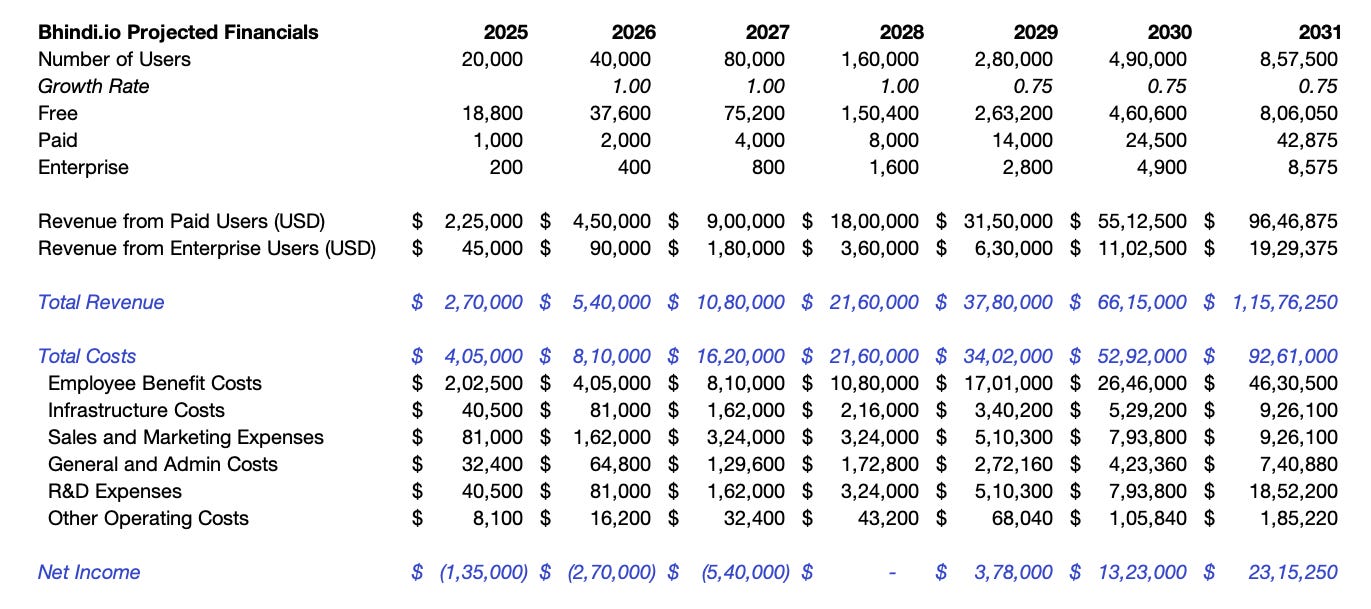
Above is a truncated financial model spanning the next 7 years for Bhindi.io from its launch date — April 2025. Here are the assumptions:
As of August 2025, Bhindi.io has over 5,000 users. This was achieved in almost a quarter, and thus annualised, this value comes to 20,000 users for 2025.
Most if not all early-stage SaaS companies that display Bhindi’s level of growth typically double their user base year-on-year until the business begins to mature. As such, a 100% growth rate on the user base is not an unnatural assumption, slowing down post break-even in Year 5. All growth rates taken are net of churn/saturation, meaning new customers minus those who leave.
95% of the user base of most SaaS businesses concentrates around the free tier. In this model, we assume a 94:5:1 split between free, paid, and enterprise users.
Given the stage Bhindi is currently at, total costs are expected to be about 150% of the given year’s revenue. As the company scales, this value diminishes from Year 4 onwards all the way down to 80% in Year 6 and 7.
Once the company hits breakeven, marketing costs are expected to slow down as well, thus leaving room for additional investments into R&D to improve Bhindi’s algorithms and models. By Year 7, R&D makes up 20% of total costs.
Using these assumptions and the above model, the next step is to calculate the terminal value3 of the company.
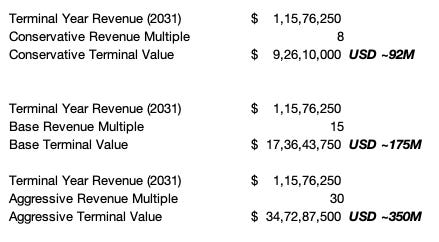
Taking 2031 as the harvest year, the terminal value of Bhindi.io has been calculated using a revenue multiples approach. This entails taking the harvest year’s revenue, applying a realistic revenue multiple basis the industry (AI SaaS), and taking the product of the two as the terminal value. As seen in the above table, three scenarios have been outlined — a conservative, base, and optimistic estimate.
To further this analysis along, the present value4 of this future expected revenue is required. The key assumption here is that of the discount rate. For this analysis, 30% is a reasonable assumption that captures both the growth opportunity of such a business and the inherent risk of a startup at this stage.
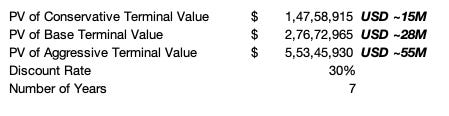
These present values are the current estimations that come out of the financial model above on what the pre-money valuation of the firm should be. Currently, Bhindi.io has raised USD 4M at a post-money valuation of USD 28M. Given the present values calculated above, the estimates provided are in the range of the firm’s current valuation, thus validating the assumptions of the financial model alongside the real expected growth.
In addition to the valuation analysis, venture capital funds also conduct a dilution exercise to understand how much their stake would be worth. One can conduct such an exercise by modelling out the cap table of the fund given publicly available data.
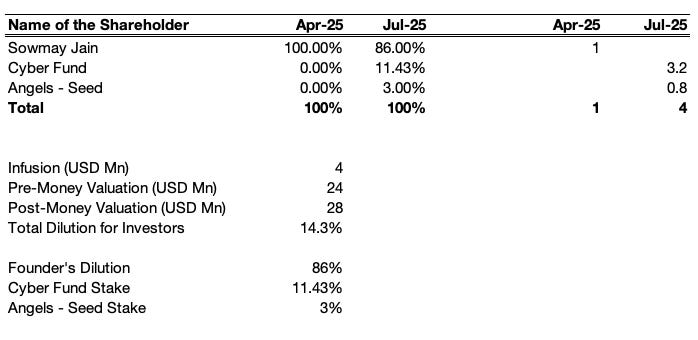
Seen above is an estimation of what Bhindi.io’s cap table as of August 2025. For clarity, here are what the elements within this table mean:
Infusion refers to the amount of new money the company has raised.
Pre-Money Valuation refers to the value of the company before the new money was infused into the firm.
Post-Money Valuation refers to the value of the company after the new money was infused into the firm.
Dilution refers to the percentage that each shareholder’s stake in the company — also known as equity — is reduced as new money is put into the business.
The mechanics are quite simple if one examines the cap table chronologically. In April 2025, Sowmay Jain (Founder) holds 100% equity in his company. The implication of this is that no other shareholders currently exist and he is the sole owner of the business. In between July and August 2025, Sowmay raised USD 4M from Cyber Fund as well as other angel investors who have backed his previous business. The assumption made here is that since Cyber Fund is the lead investor of this pre-seed round, the fund would contribute between 80-90% of the new capital.
As new money is pumped into the business, other shareholders (in this case, just Sowmay) give up a certain percentage of their equity and distribute this on a pro-rata basis according to the amount each investor contributes to the new round. The total dilution is carried out by dividing the total amount of fresh capital divided by the post-money valuation. This is then used to determine how much each investor will give up and gain as the business takes on additional funding. Thus, Sowmay gives up ~14% of his business and distributes this across Cyber Fund and the angel investors according to the assumed ratio in which they contributed to the new round.
Bhindi.io’s 4Ms
Market: The AI SaaS market is large and growing, spanning multiple industries such as FinTech, marketing, and software development with the potential to attract millions of users. As more people are gaining access to these AI tools, there is an increasing demand for automation and unified productivity platforms that sit on top as an app of apps. Although this market is nascent, it is scaling rapidly with multiple AI assistants. Even the incumbent workflow automation tools are currently integrating AI into their products to service their clients better. Agentic AI in this context marks a difference due to the very nature of the technology.
Management: The founder of Bhindi.io is Sowmay Jain, an experienced entrepreneur with a strong track record in DeFi platforms (Instadapp, Fluid.io), and is trusted by top-tier investors. Given his background and the current engineering requirements of Bhindi.io, it is likely that the founder has strong engineering and AI talent as part of the team.
Model: Bhindi.io offers an agentic AI SaaS platform that automates workflows across 100+ apps using AI-driven agents. The pricing structure follows a freemium SaaS model with paid subscriptions (~USD 20/month) and enterprise contracts, generating revenue from both SMBs and enterprises. As expected of a high-growth SaaS company, infrastructure, sales & marketing, and R&D investments are on the higher side, however this is offset by the scalability of cloud-based AI automation with user growth and platform adoption. The business comes with a strong technological moat with agentic AI as it orchestrates complex workflows, thus reducing AI fatigue. Finally, the business serves several use cases across crypto, FinTech, marketing, and developer tools.
Momentum: Bhindi.io has shown rapid growth given the 5,000+ users it has managed to attract in its first quarter of existence. The firm has also raised USD 4M from reputed AI-focused investors, thus validating the market’s interest in their approach to agentic AI. The differentiation they are attempting to bring to the table lies in reducing AI fatigue and tool overload. Overall, the business has shown high user adoption, solid funding, and a differentiated product solution.
GameRamp

GameRamp is an AI-native publishing platform designed to help mobile game developers and consumer apps scale and monetise faster with the help of automation and AI. The business leverages reinforcement learning and embedded financing tools to optimise in-game monetisation, personalisation, and capital access.
Core Products:
Sentinel: A reinforcement learning platform for real-time personalisation of game economies and monetisation.
Grow: An embedded financial tool offering developers easy access to capital via a streamlined interface.
Currently, the firm has run early pilots in India, Vietnam, and Turkey, showing promising results of 40-60% increased revenue for those studios that have used GameRamp tools. The business model primarily works on an API-based pricing system that is linked to developer usage, alongside credit fees through embedded financing. Moreover, the team has shown a blend of expertise across machine learning, product growth, and investing, guided strongly by a group of well experienced founders and investors.
GameRamp aims to become a foundational layer for mobile game studios and app developers, providing essential automation and AI-driven insights to compete in competitive global markets.
Valuing GameRamp
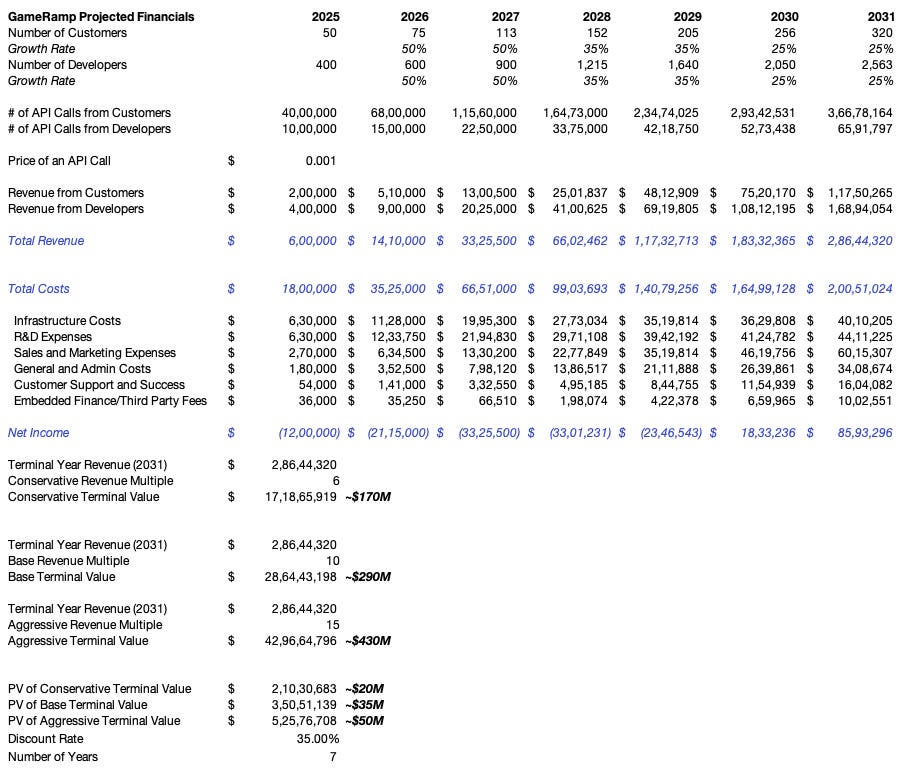
Given the limited publicly available data, modelling out GameRamp’s financials was tricky but not impossible. Here are the assumptions:
As of August 2025, GameRamp has 10-15 customers (game studios, game labs, etc.) and 100+ developers on their waitlist. Given that the business began in April 2025, and that in a quarter these are the numbers, annualised they are ~4x.
Growth rates are net of churn/saturation.
For simplicity, API call rate has been fixed at $0.001. Introducing ARPU and tiered pricing would lead to complexity and thus has been avoided.
Cost structure adapts according to typical high-growth SaaS businesses as they grow and mature.
Discount rate is similar to early-stage SaaS businesses and prices in the risk of the stage alongside the growth opportunity that this investment presents.
In the financial model constructed above, the harvest year is 2031, and three scenarios — conservative, base, and optimistic have been modelled. For each scenario a terminal value has been calculated and then discounted back to provide an estimate of the firm’s pre-money valuation. Given the current state of the Infra-SaaS sub-sector and the strong uptake that the gaming sector has seen in recent years, the pre-money calculations seem in line with comparable deals that have taken place in 2025.
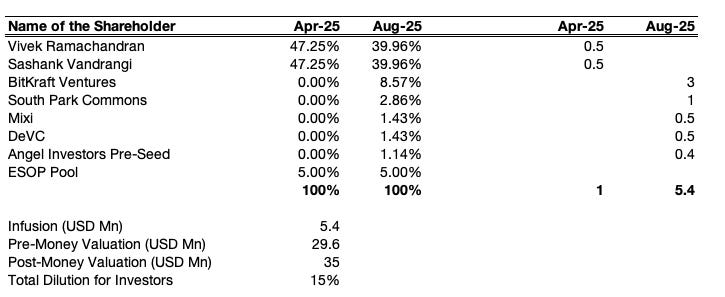
The above cap table construction shows:
Initial infusion by founders is USD 1M to get the operation off the ground.
Total dilution for new investors is 15%, which is generally the trend for a USD 5.4M raise assuming a USD 35M post-money valuation.
Each founder is diluted but retains meaningful control and signals founder commitment while showing realistic single-round dilution.
BitKraft Ventures is the lead investor at 8.57% and other institutional/angel investors are at smaller percentages which matches normal syndicate participation and ensures that no party dominates the round.
ESOP pool is fixed at 5% for early hires and may increase as the company scales.
GameRamp’s 4Ms
Market: GameRamp is in the gaming infrastructure and AI-powered game publishing market, which is a booming industry that is projected to have revenues nearing USD 200B+ globally by 2025 on the back of a 4-7% CAGR in core gaming SaaS and AI segments. The intersection between mobile gaming growth, AI personalisation, and cloud infrastructure helps create a significant white space for platforms like GameRamp with an estimated TAM in the hundreds of millions to billions over a medium-term horizon.
Although this industry is competitive, GameRamp’s AI-native publisher and developer centric tools put it in a strong position to capture market share. Finally, GameRamp is currently leveraging the mega-trend of artificial intelligence adoption, the widespread transition to cloud, and the ever-increasing mobile consumption that is pushing infrastructure demand.
Management: The founders Vivek Ramachandran and Sashank Vandrangi bring a combination of technical expertise, domain knowledge, and credible entrepreneurial backgrounds that are key for early-stage success. The business is backed by BitKraft Ventures who is a strategic investor with deep gaming VC experience and provides not just capital but also market access and growth guidance.
Model: Usage-based SaaS with API call pricing that aligns revenue directly with customer engagement which then creates scalable and recurring revenue streams. Ideally, as scale is achieved the business can expect strong gross margins driven by software delivery, cloud scalability, and cost controls on infrastructure and R&D.
Momentum: Successfully booked a USD 5.4M pre-seed round led by BitKraft Ventures which reflects strong market validation and execution momentum. Currently has 10-15 enterprise customers and 100+ developers on their waitlist which underpins the revenue ramp and potential platform stickiness. Strong recognition in multiple sector reports and recognised by strategic investors which raises GameRamp’s profile and accelerates the potential partnership opportunities.
Stance Health

Stance Health is a Bangalore-based health-tech startup founded in 2024 by Rohit Arora and Ninad Karandikar. The business is focused on transforming musculoskeletal (MSK) care in India which includes the treatment for muscles, bones, joints, ligaments, and tendons.
Full-Stack MSK Care: Stance Health offers a hybrid care platform that combines in-person treatment and online recovery plus monitoring programs at its quickly growing network of rehab centres.
Technology Integration: Stance Health uses proprietary technology (AI-based motion sensors, remote assessments, data analytics) to provide structured, out-come focused recovery journeys all the way from diagnosis to recovery.
Patient-Centricity: India has a fragmented MSK ecosystem by blending clinical, physiotherapy, and consumer health best practices. The process includes in-centre consultations, personalised exercise protocols, and ongoing monitoring through tech-driven interventions.
Valuing Stance Health
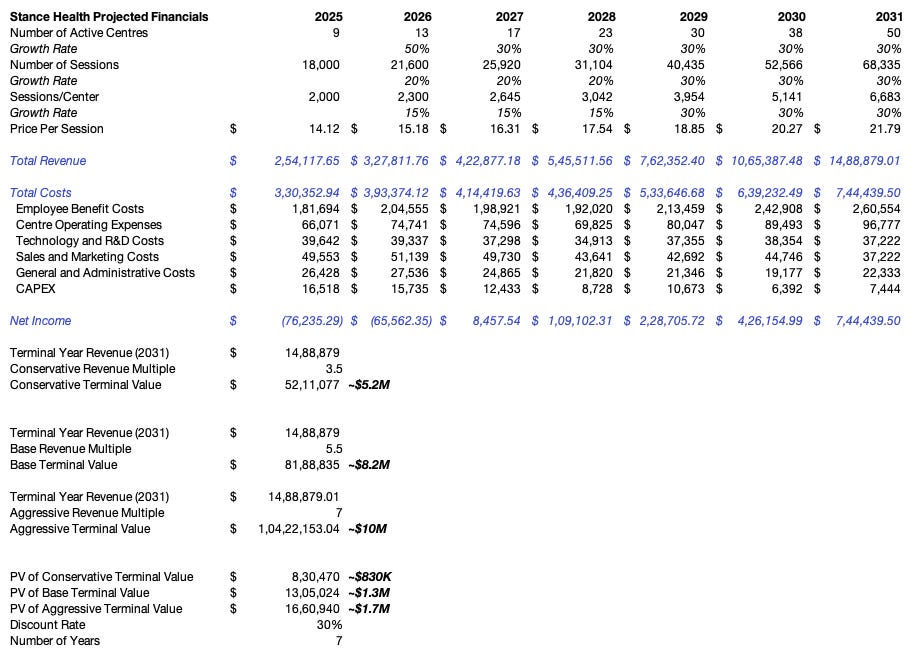
Here are the assumptions of Stance Health’s financial model:
Currently, the business runs in three locations in Bangalore and has plans to include 6 more centres by the end of the year and thus the base number of centres in 2025 are 9.
Growth rates are net of churn.
As the business scales post Year 2 across different geographies, centres are expected to grow at a steady state of 30% year on year.
With the growth in centres, the average growth in number of annual sessions is expected to be 25%.
Given the nature of healthcare businesses, employee benefit costs are expected to take the lion’s share of the total business costs.
For simplicity, this model has not considered ancillary streams of revenue such as bundling of plans, remote monitoring services, orthotics, & clinical partnerships.
A key point to note here is that terminal values of the business and thus the current assumed pre-money valuation of the business is affected greatly by the healthcare costs (i.e. the cost of each session). Relative to western countries, the cost of healthcare in India is known to be considerably lower and thus the per session cost (as given by Stance Health’s customer representative) stands at INR 1,200 or ~USD 14. If per session costs were in tandem with actual prices in the United States, this model would look considerably different.
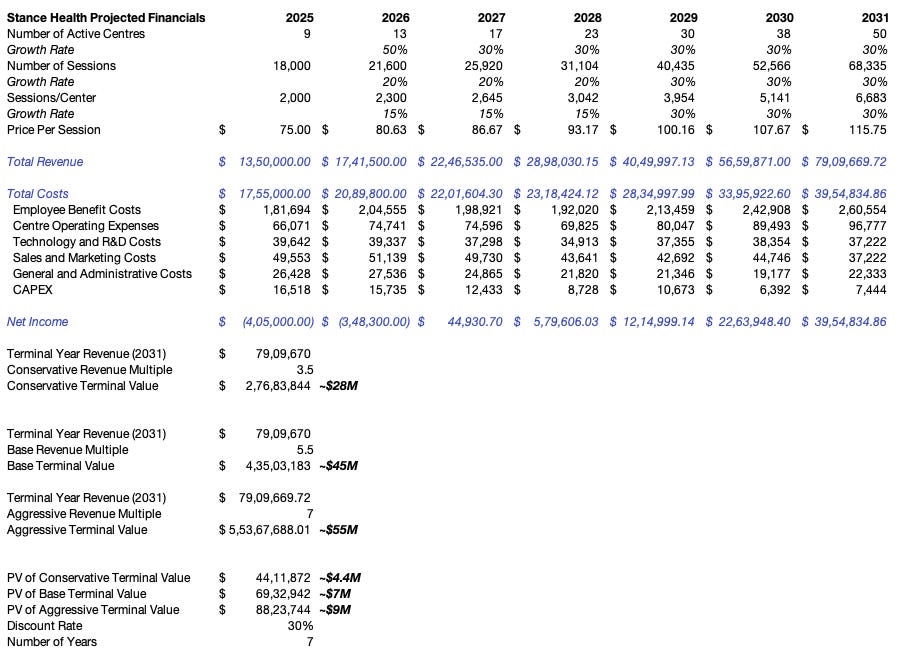
Applying some sensitivity analysis, if the base per session cost is assumed to be USD 75 (INR ~6,500), then clearly, the business’ valuation is ~5-6x. However, it is unlikely that at this price point a large customer base can be generated in a country like India, thus growth rates will vastly differ and therefore, this model is unrealistic.
Given that the health-tech companies in 2025 are trading at 4-6x revenue multiples, accounting for business growth, business risk, and tech integration, realistic revenue multiples have been taken to arrive at the terminal values across the conservative, base, and optimistic scenarios.
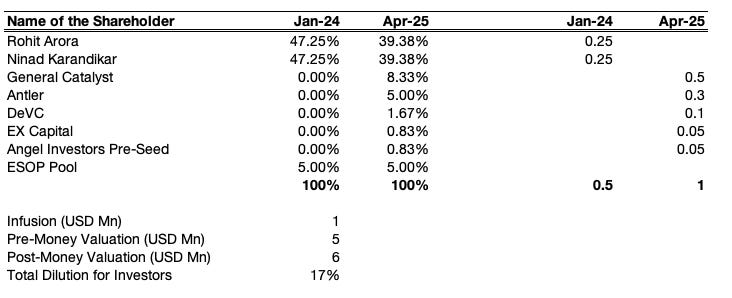
The above cap table structure is fairly straightforward. A post-money valuation of USD 6M is assumed given the firm’s early stage and that generally pre-seed rounds of this kind generally command an investment cheque of ~USD 1M - 3M and a valuation of ~USD 4 - 5M. Thus, total equity given to additional investors is ~20% which is in line with industry figures.
Stance Health’s 4Ms
Market: India’s physiotherapy market is forecasted to reach close to USD 2B by 2030, driven primarily by an aging demographic, India’s penchant for sedentary lifestyles, and the rising awareness of non-pharma recovery. The digital MSK market is growing at an even faster rate and is expected to reach USD 750M by 2032. Although the global market is even larger, in the Indian context, higher instances of unmet needs and low standardisation are expected to underpin the large expected growth of this market.
Additionally, this market is incredibly fragmented with a good portion of patients relying on episodic orthopaedic visits and generic physiotherapy rather than targeted, sustainable physiotherapy. Thus arises a clear gap for integrated, tech-enabled, high-quality physiotherapy care centres.
Finally, other tailwinds such as the growing adoption of technology, urban incomes, and MSK disorder burden, have led to a greater willingness within patients to pay for quantified, outcome-oriented rehab.
Management: Founder Rohit Arora comes with deep multi-sector startup experience across Swiggy, Nestaway, and Bounce, giving him depth in managing business operations, P&L management, and GTM. Ninad Karandikar comes with a similar background in managing business operations at Swiggy, and more importantly has exposure within the healthcare sector through his experience as a regional business head of Portea. Alongside the two founders stand General Catalyst, Antler, and Sword Health founders as investors and the Swiggy co-founders and clinical leaders from Manipal and Kauvery Hospitals as providers of deep domain knowledge, health-tech scaling expertise, and patient capital.
Model: Stance Health runs its business by blending offline MSK clinics with their proprietary digital rehab alongside its AI-driven monitoring system (“Healthflex”). They run a three phase structure of 3Rs — Reassess, Restore, Reignite — which is targeted towards optimising both patient onboarding and clinical outcomes. Using an omni-channel delivery system, the business integrates in-centre clinical evaluation with evidence-based therapy, and app-guided home exercise plans. Finally, Stance Health is scalable through centralised technology that boosts economics over time; early traction has shown 12,000+ sessions in 8 months with a ~3x retention vs. industry. Moreover, the business works with AI-based diagnostics, real-time tracking, outcome-focused rehab that gives it a technological edge over its local competitors.
Momentum: Within the first few months of operation, the firm has managed to do 12,000+ sessions and achieve high patient retention and strong satisfaction. Market validation has been achieved thanks to global tier-1 backers providing USD 1M in capital. Received endorsements from orthopaedic heads and are expecting a rapid expansion of new MSK centres as they scale their platform pan-India.
Investment Risks
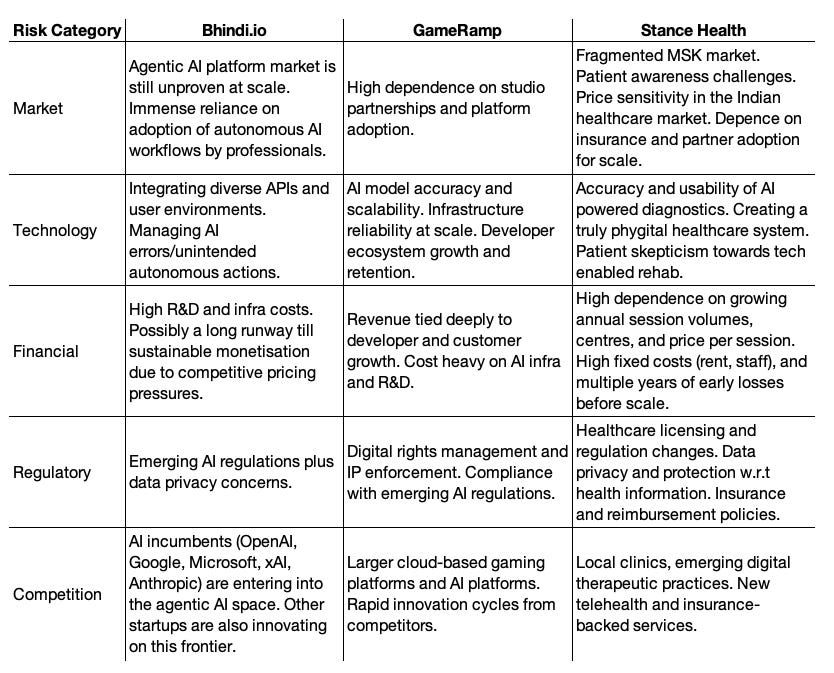
With the advent of emergent technology such as artificial intelligence and machine learning, there lies a considerably opportunity to create true and lasting value for both companies and consumers at scale. Companies like Bhindi.io, GameRamp, and Stance Health, although in entirely different sectors utilise much of the same tech-stack to disrupt existing markets or create new markets entirely. Although with a little spreadsheet tinkering and modelling these businesses seem attractive and poised for success, there are still considerable risks involved for any investor when entering the cap table of such nascent products and services.
Footnotes
As time passes, this could become a series where new businesses come into my field of vision and my assumptions and modelling skills only get better! ↩
The Price-to-Earnings (P/E) ratio is a financial metric that measures a company's current share price relative to its earnings per share (EPS). It shows how much investors are willing to pay for each unit of a company's earnings.
Key Points: ↩Formula:
P/E Ratio = Market Price per Share/Earnings per Share (EPS)
A high P/E ratio may imply that the stock is overvalued or that investors expect high future growth.
A low P/E ratio could indicate the stock is undervalued or that the company may be experiencing difficulties.
It is useful for comparing the valuation of companies in the same industry or tracking a company's valuation over time.
The terminal value of a company is the estimated value of the business beyond the forecast period in financial modeling, typically in discounted cash flow (DCF) analysis. It represents the present value of all future cash flows the company is expected to generate after the explicit forecast period, assuming stable growth indefinitely. ↩
Present value (PV) is the current worth of a sum of money or stream of cash flows expected to be received in the future, discounted back to today’s value using a specific rate of return (called the discount rate). ↩
Money today is worth more than the same amount in the future due to the potential to earn interest or returns (time value of money).
Present value tells you how much a future amount of money is worth in today’s terms.
It is widely used in finance and investing to evaluate the attractiveness of future cash flows, investments, or projects.